Blog Single

01 paź

We supplied ceiling-mounted SFCU-CW fan coil units for technical spaces

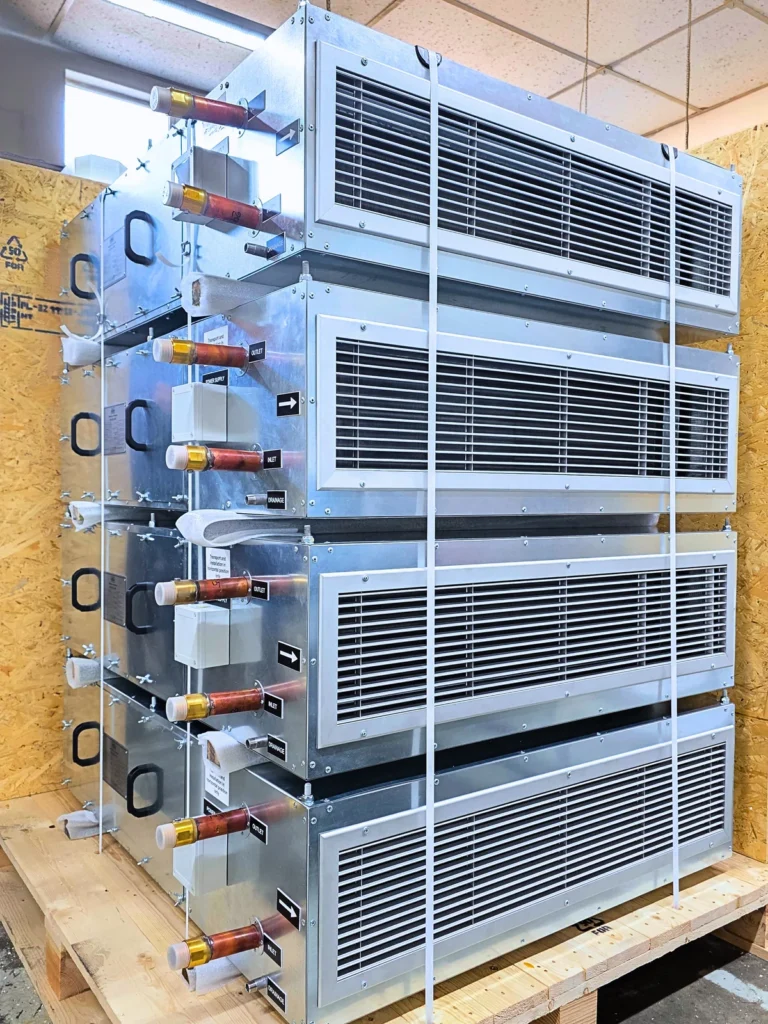
Ceiling-mounted SFCU-CW fan coil units supplied by Sedina HVAC

Sedina HVAC supplied fan coil units configured to meet the specific operating requirements of marine technical spaces. The units combine a compact ceiling-mounted arrangement with easy access for servicing, a cooling section selected to meet the required operating point, integrated electric heating, air filtration, as well as condensate collection and drainage.

Application Technical rooms on board a marine vessel
Cooling medium Chilled water
Design airflow 1,700 m³/h
Heat-exchanger duty points 7.45–8.77 kW
Heating capacity 2.5 kW
Installation Ceiling-mounted arrangement with removable service access

Project Requirements and Application

Project requirements included:

  • selection of components and materials to match the specified operating conditions and required performance parameters
  • application of appropriate acoustic insulation with very good fire performance parameters, enhancing operational safety
  • equipping the units with an electric heater, allowing additional air heating depending on actual needs

The delivered units will operate in:

  • engine rooms
  • switchboard and electrical rooms
  • thruster / bow thruster rooms
  • technical spaces where precise temperature control is required

Technical Configuration and Performance

The required design airflow is 1,700 m³/h. The selected fan operating point is 1,736 m³/h at 300 Pa static pressure and 2,004 rpm.

Air movement is provided by a single belt-driven fan in each configuration, offering a straightforward and serviceable solution while allowing the fan operating point to be matched to the required airflow. The electric motor is rated at 0.87 kW and supplied at 3 × 440 V, 60 Hz, with IP55 enclosure protection.

Depending on the heat exchanger configuration and design conditions, the cooling capacity is 7.45 kW, 8.54 kW or 8.77 kW. The 7.45 kW and 8.54 kW configurations use three-row heat exchangers, while the 8.77 kW configuration uses a four-row heat exchanger with a larger heat-transfer surface. This allowed the same overall ceiling-mounted unit concept to be applied across different thermal requirements.

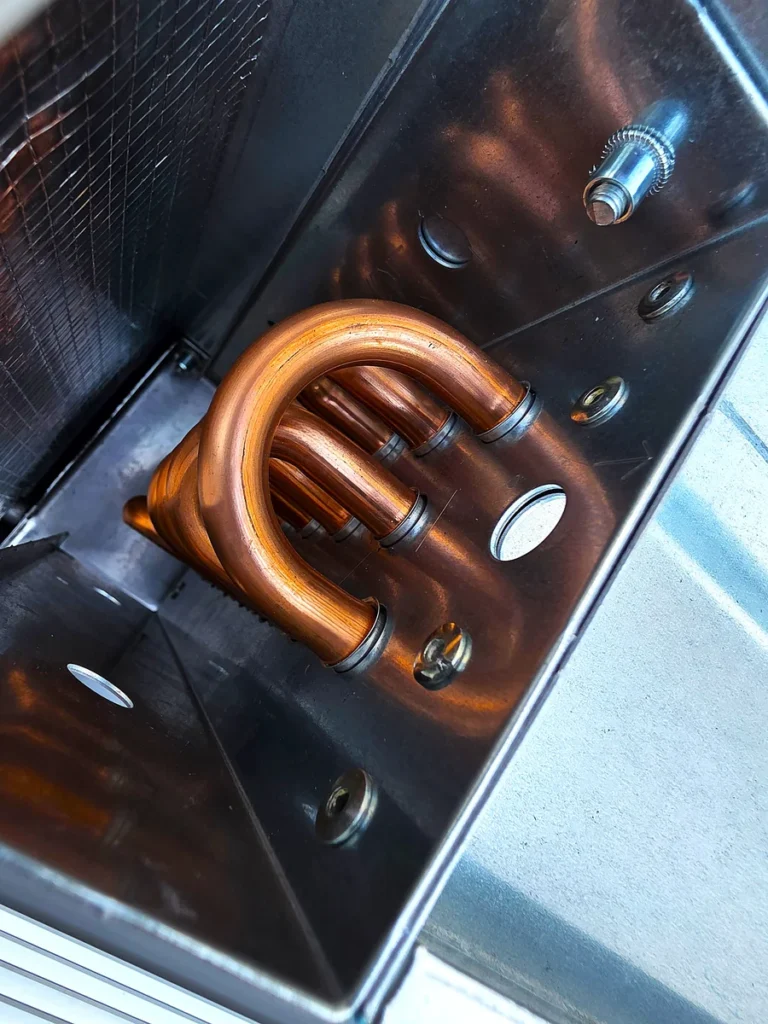
Chilled-water heat exchanger in a Sedina HVAC SFCU-CW fan coil unit
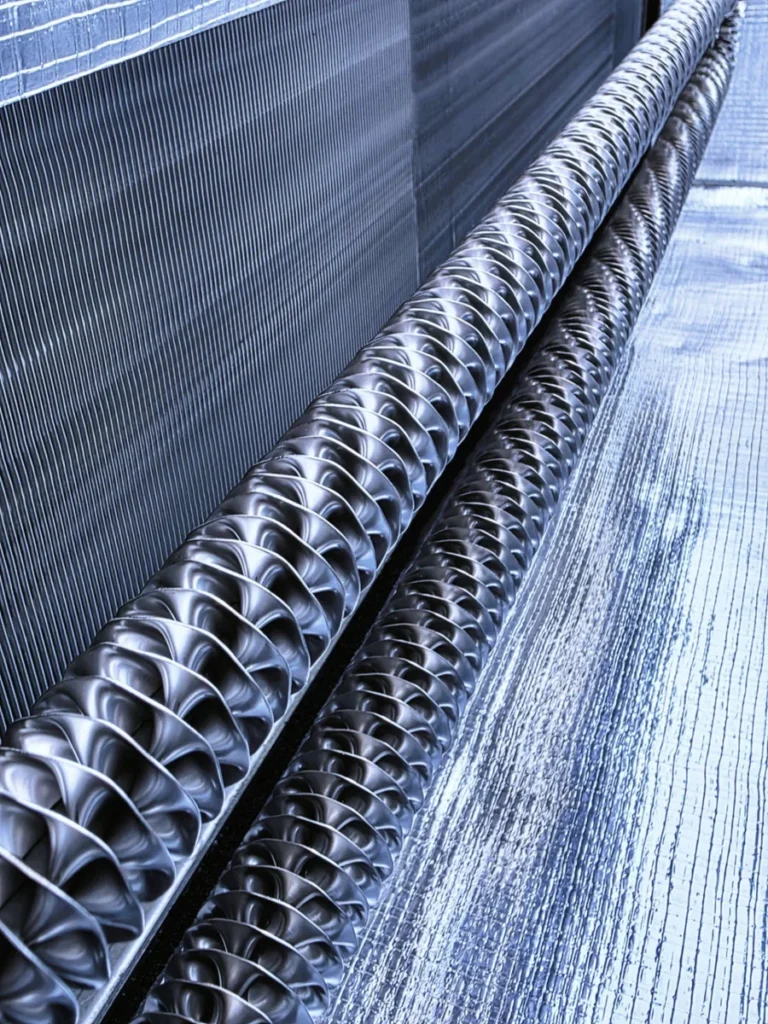
Electric heater inside a Sedina HVAC SFCU-CW fan coil unit

Air filtration is provided by a G3 filter according to EN 779, as specified for the project, with an initial pressure drop of 40 Pa and a final pressure drop of 200 Pa. Condensate is collected in a 1.0 mm stainless-steel drip tray and discharged through the drainage connection.

The unit frame, fan casing and insulating-panel casing are manufactured from galvanised carbon steel. A 12 mm layer of Alu insulation helps to reduce noise transmission through the unit casing, while meeting a B-s1,d0 classification in order to meet the project requirements. The configuration also incorporates 2.5 kW of electric heating, providing additional heating capacity where required by the conditions in the space served by the unit.

Fan and Motor Arrangement

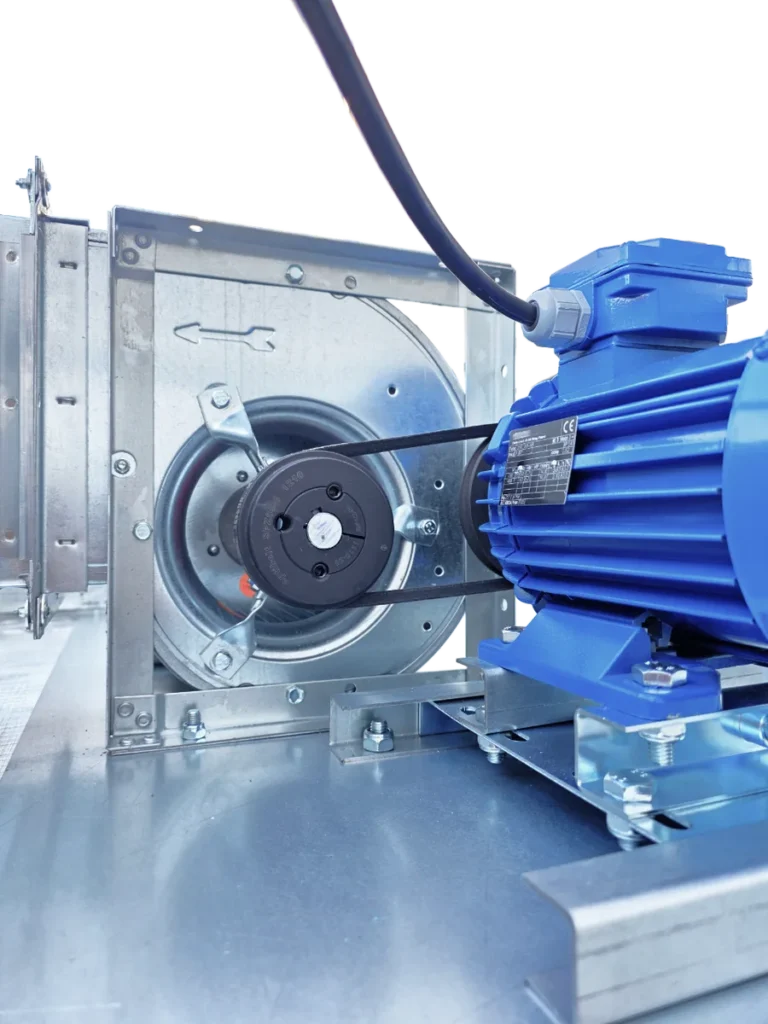
The motor is mounted on an adjustable sliding base, allowing its position relative to the fan to be adjusted. This enables the correct belt tension and pulley alignment to be set and, consequently, allows the fan speed and airflow to be selected according to the required operating conditions.

The fan and motor are mounted on a common rigid supporting frame designed to withstand the dynamic loads generated by the motor–fan assembly. In addition, vibration isolators and flexible connections limit the transmission of vibrations from the fan assembly to the unit structure, reducing operational loads and noise levels and contributing to longer component service life.

Belt-driven fan and electric motor assembly for a Sedina HVAC fan coil unit

Installation and Service Access for Ceiling-Mounted Fan Coil Units

Ceiling mounting places particular emphasis on access planning, maintaining the required airflow to the heat exchanger, and providing sufficient space for servicing. The project arrangement therefore includes a removable panel for servicing the fan, electric motor and filter. To ensure unobstructed airflow and convenient access for maintenance, the manufacturer indicated in the project drawing that approximately 600 mm of service space should be provided adjacent to the unit, along with approximately 600 mm of free space at the recirculation-air inlet.

The units are arranged for attachment to a suitable ceiling supporting structure using steel profiles and defined mounting points. This maintains the compact ceiling-mounted arrangement while preserving access to the principal internal components.

Additional installation requirements include:

  • installation on a supporting structure in accordance with the project documentation, including mounting-point spacing and load capacity;
  • orientation consistent with the required airflow direction, from the fan through the heat exchanger into the room;
  • installation by personnel qualified for shipboard installation work.

Summary

At Sedina HVAC, our flexible approach allows us to offer non-standard, tailor-made solutions. In this project, in accordance with the customer’s request, all wooden packaging materials, including pallets, can be marked with the ISPM-15 stamp (in compliance with IPPC), confirming that they had been properly treated. In marine and offshore applications, equipment reliability and operational safety are key engineering considerations. For this reason, we approach each project as an engineering task rather than simply a shipment.

Leave A Comment